
Case Study Analysis | Fairfield School of Business | Ravensbourne University of London | BSM24001
The Case Study Analysis module (BSM24001) offered through Fairfield School of Business in partnership with Ravensbourne University of London is designed to equip students with critical business analysis, decision-making, communication, and employability skills. The module encourages learners to apply theoretical business concepts to real-world organizational challenges through case studies, group discussions, and reflective practice.
In today’s competitive business environment, employers seek graduates who can analyze complex situations, identify strategic solutions, communicate effectively, and demonstrate professional skills. The BSM24001 module addresses these expectations by combining academic learning with practical assessment activities that mirror workplace scenarios.
The module consists of three key assessment components: a Multiple-Choice Quiz, a Group Debate worth 50% of the overall grade, and an Employability Skills Log and Reflection. Each component contributes to developing essential competencies required in modern business environments.
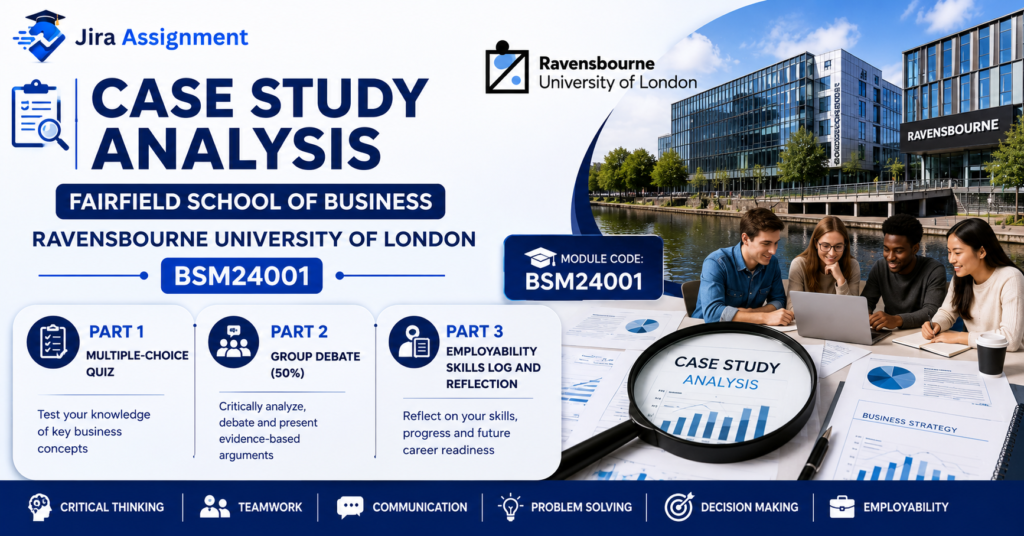
Highlights
Case Study Analysis Module Code: BSM24001
The BSM24001 module focuses on developing students’ ability to evaluate business situations, interpret data, and propose evidence-based recommendations. Through the use of case studies, students gain practical experience in examining organizational problems and understanding the factors that influence business decisions.
Case study analysis is a widely used learning method in business education because it bridges the gap between theory and practice. Rather than simply memorizing concepts, students are required to apply knowledge to realistic scenarios that reflect challenges faced by organizations in various industries.
Learning Objectives of BSM24001
- Develop critical thinking skills
- Improve analytical abilities
- Strengthen business communication
- Enhance teamwork and collaboration
- Build decision-making capabilities
- Foster employability skills
- Encourage reflective learning
- Apply business theories to practical situations
Key Skills Developed
| Skill Area | Importance |
|---|---|
| Critical Thinking | Evaluating complex business problems |
| Problem Solving | Identifying effective solutions |
| Communication | Presenting ideas clearly |
| Teamwork | Collaborating with others |
| Leadership | Managing group activities |
| Reflection | Learning from experiences |
| Research | Supporting arguments with evidence |
| Decision-Making | Making informed business choices |
These skills are highly valued by employers and contribute significantly to graduate employability.
Ravensbourne University of London Module Code: BSM24001
Ravensbourne University of London is recognized for its focus on industry-relevant education and practical learning experiences. The BSM24001 module reflects this commitment by encouraging students to engage with real-world business challenges and develop transferable skills that can be applied across different professional settings.
The module emphasizes active participation, independent learning, and collaborative work. Students are expected to demonstrate not only academic understanding but also professional behaviors such as effective communication, teamwork, and self-reflection.
Benefits of Studying BSM24001
- Exposure to real business scenarios
- Development of workplace-ready skills
- Improved confidence in professional settings
- Enhanced analytical capabilities
- Better understanding of organizational challenges
- Stronger communication and presentation skills
The knowledge and competencies gained through this module can support students throughout their academic journey and future careers.
Part 1: Multiple-Choice Quiz
The Multiple-Choice Quiz serves as an assessment tool designed to evaluate students’ understanding of key concepts covered throughout the module. It tests knowledge of business theories, analytical frameworks, and practical applications relevant to case study analysis.
Multiple-choice assessments provide an efficient way to measure comprehension and encourage students to engage with course materials consistently. The quiz may cover topics such as strategic management, organizational behavior, leadership, decision-making, and business ethics.
Objectives of the Quiz
- Assess understanding of module content
- Test application of business theories
- Reinforce learning outcomes
- Encourage independent study
- Measure knowledge retention
Advantages of Multiple-Choice Assessments
| Advantage | Description |
|---|---|
| Quick Evaluation | Efficient assessment method |
| Broad Coverage | Tests multiple topics |
| Objective Marking | Reduces grading bias |
| Knowledge Check | Measures understanding |
| Feedback Opportunity | Identifies learning gaps |
Preparing effectively for the quiz requires reviewing lecture materials, reading recommended resources, and practicing the application of theoretical concepts to practical situations.
Part 2: Group Debate (50%)
The Group Debate is the most significant component of the module, accounting for 50% of the overall assessment. This activity requires students to work collaboratively, research assigned topics, and present well-supported arguments on business-related issues.
Debates encourage active learning by challenging students to consider multiple perspectives, defend their viewpoints, and critically evaluate opposing arguments. Through this process, learners develop essential skills that are highly valued in professional environments.
Purpose of the Group Debate
The debate aims to:
- Improve critical thinking
- Strengthen communication skills
- Enhance teamwork abilities
- Develop persuasive argumentation
- Encourage evidence-based decision-making
- Foster confidence in public speaking
Skills Gained Through Debates
| Skill | Benefit |
|---|---|
| Public Speaking | Increased confidence |
| Research | Better information analysis |
| Teamwork | Effective collaboration |
| Critical Thinking | Stronger reasoning skills |
| Communication | Clear presentation of ideas |
| Leadership | Managing group responsibilities |
Tips for Success in Group Debates
- Conduct thorough research.
- Use credible academic sources.
- Practice presenting arguments.
- Anticipate counterarguments.
- Collaborate effectively with team members.
- Stay professional during discussions.
- Support claims with evidence.
Debates simulate workplace situations where professionals must justify decisions, negotiate solutions, and communicate effectively with stakeholders.
Part 3: Employability Skills Log and Reflection
The Employability Skills Log and Reflection component encourages students to evaluate their personal and professional development throughout the module. Reflective practice is an important learning strategy that helps individuals identify strengths, weaknesses, achievements, and areas for improvement.
Employability skills extend beyond academic knowledge and include qualities such as communication, teamwork, adaptability, leadership, and problem-solving. Employers increasingly seek candidates who can demonstrate these transferable skills.
Purpose of the Employability Skills Log
The log allows students to:
- Track skill development
- Reflect on learning experiences
- Identify strengths and weaknesses
- Set future development goals
- Demonstrate professional growth
- Connect academic learning with career aspirations
Employability Skills Developed
| Skill | Workplace Value |
|---|---|
| Communication | Effective interaction |
| Teamwork | Collaborative success |
| Leadership | Guiding projects and teams |
| Adaptability | Responding to change |
| Problem Solving | Overcoming challenges |
| Time Management | Meeting deadlines |
| Professionalism | Workplace readiness |
Importance of Reflection
Reflection helps students understand how experiences contribute to learning and development. By critically evaluating their performance, individuals can identify strategies for improvement and make more informed decisions about future career goals.
A strong reflective log should include:
- Description of experiences
- Analysis of learning outcomes
- Identification of strengths
- Recognition of challenges
- Plans for future development
- Connection to employability skills
Importance of Case Study Analysis in Business Education
Case study analysis remains one of the most effective teaching methods in business education because it provides practical exposure to real-world situations. Students learn to apply theoretical concepts, evaluate evidence, and make recommendations based on analysis.
Benefits of Case Study Learning
- Encourages active learning
- Develops analytical thinking
- Improves decision-making skills
- Enhances communication abilities
- Strengthens professional competencies
- Increases industry awareness
These benefits contribute to both academic success and career readiness.
Conclusion
The Case Study Analysis module (BSM24001) at Fairfield School of Business and Ravensbourne University of London provides students with valuable opportunities to develop analytical, communication, teamwork, and employability skills. Through the Multiple-Choice Quiz, Group Debate, and Employability Skills Log and Reflection, learners gain practical experience that prepares them for academic achievement and professional success.
The module emphasizes the application of business theories to real-world situations, helping students become confident problem solvers and effective communicators. By actively engaging with the assessment components, students can enhance their employability, strengthen their professional competencies, and build a solid foundation for future career development.