
Pacific College of Technology ICT60220 Advanced Diploma of IT (Networking) Solutions [100% Human Written]
As organisations become more vulnerable to cyber threats, so does the demand for networking professionals with cyber security skills continue to rise. At Pacific College of Technology, students studying the ICT60220 Advanced Diploma of Information Technology (Networking) are typical of students learning to apply practice and skills to the design, implementation and management of secure network infrastructure.
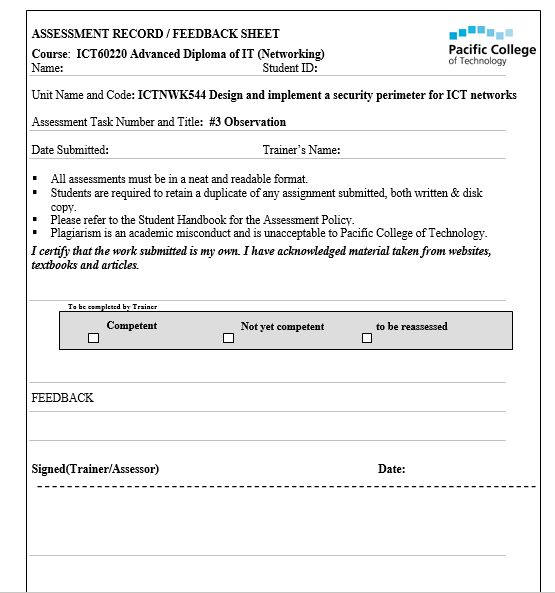
ICTNWK544 Design and Implement a Security Perimeter for ICT Network is one of the most crucial units in this qualification. The emphasis of this unit is on the use of sound security perimeter design to ensure network protection, risk management, access control, implementing firewalls, and practicing cybersecurity best practices.
This assessment is difficult for many of the students in the sense that it demands analytical skill as well as knowledge of the technical process. Many assignments are scenarios with real-world applications where students are expected to consider security threats, come up with a solution and provide reason(s) justifying their design choices based on industry-standard practices.
Our one-stop, professional academic assistance is available to students taking a course in networking, cyber security or information technology. Our well trained professionals help students with research, technical documentation, report writing, project network design and cyber security analysis ensuring adherence to academic needs.
Highlights
- Understanding the ICTNWK544 Assignment
- Why Students Find ICTNWK544 Challenging
- Importance of Security Perimeter Design
- Core Components of a Security Perimeter
- Risk Assessment in Network Security
- Cybersecurity Compliance and Industry Standards
- Technical Documentation and Reporting
- Benefits of Professional ICTNWK544 Assignment Help
- Why Choose Jira Assignment?
- Get Expert ICTNWK544 Assignment Help Today
- Related Assignment Help Services
- Conclusion
Understanding the ICTNWK544 Assignment
The ICTNWK544 Design and Implement a Security Perimeter for ICT Network unit focuses on developing secure network environments capable of protecting business systems, sensitive information, and communication channels from external and internal threats.
Students are expected to understand how security perimeters function within modern IT infrastructures and how multiple security controls work together to reduce vulnerabilities.
The assignment typically requires students to demonstrate knowledge of:
- Network security architecture
- Security perimeter design
- Firewall implementation and management
- Virtual Private Networks (VPNs)
- Intrusion Detection Systems (IDS)
- Intrusion Prevention Systems (IPS)
- Risk assessment methodologies
- Access control mechanisms
- Security monitoring procedures
- Cybersecurity compliance requirements
Successfully completing the assessment requires a combination of technical expertise, research skills, and practical understanding of cybersecurity principles.
Why Students Find ICTNWK544 Challenging
Many students struggle with this unit because cybersecurity concepts are often more complex than traditional networking topics. Understanding theoretical concepts is one thing, but applying them to practical business environments requires a deeper level of knowledge.
Some common challenges include:
- Designing secure network infrastructures
- Configuring firewall policies
- Understanding network vulnerabilities
- Evaluating security risks
- Implementing VPN solutions
- Applying cybersecurity frameworks
- Writing technical reports
- Documenting network security procedures
- Justifying security recommendations
Students frequently find it difficult to connect academic concepts with real-world security challenges faced by modern organizations.
Importance of Security Perimeter Design
A security perimeter serves as the first line of defense between an organization’s internal network and external threats. It helps control access, monitor traffic, and prevent unauthorized users from reaching sensitive systems.
An effective security perimeter typically includes multiple layers of protection rather than relying on a single security solution.
Key objectives include:
- Preventing unauthorized access
- Protecting confidential information
- Monitoring network traffic
- Detecting cyber threats
- Managing user authentication
- Ensuring regulatory compliance
- Reducing cybersecurity risks
Organizations across all industries rely on strong security perimeter designs to protect critical business assets and maintain operational continuity.
Core Components of a Security Perimeter
Understanding the various components of a network security perimeter is essential for achieving success in ICTNWK544 assignments.
Firewalls
Firewalls act as gatekeepers that control incoming and outgoing network traffic based on predefined security rules.
Students may be required to evaluate:
- Packet filtering firewalls
- Stateful inspection firewalls
- Next-generation firewalls
- Application-layer firewalls
Proper firewall configuration is critical for preventing unauthorized access while allowing legitimate communication.
Virtual Private Networks (VPNs)
VPNs provide secure communication channels between remote users and organizational networks.
Benefits of VPN implementation include:
- Data encryption
- Secure remote access
- Protection against interception
- Improved privacy
Students are often required to recommend VPN solutions suitable for business environments.
Intrusion Detection and Prevention Systems
IDS and IPS technologies help organizations identify and respond to suspicious network activity.
Key functions include:
- Threat detection
- Attack prevention
- Traffic analysis
- Security monitoring
- Incident reporting
Understanding how these systems integrate into a security perimeter is an important learning outcome of the unit.
Access Control Mechanisms
Access control ensures that users can only access resources relevant to their roles and responsibilities.
Examples include:
- Role-Based Access Control (RBAC)
- Multi-Factor Authentication (MFA)
- User authentication systems
- Privileged access management
These controls reduce the risk of unauthorized access and insider threats.
Risk Assessment in Network Security
Risk assessment is a fundamental aspect of network security planning. Organizations must identify potential threats and evaluate their impact before implementing security controls.
Students are often required to assess risks such as:
- Malware attacks
- Phishing campaigns
- Data breaches
- Ransomware incidents
- Insider threats
- Unauthorized access
- Network vulnerabilities
A well-prepared assignment should explain how identified risks influence security design decisions and mitigation strategies.
Cybersecurity Compliance and Industry Standards
Modern organizations must comply with various cybersecurity standards and regulations to protect sensitive information and maintain customer trust.
Students may need to reference industry frameworks such as:
- ISO 27001
- NIST Cybersecurity Framework
- CIS Security Controls
- Australian Cyber Security Centre (ACSC) Guidelines
Understanding these frameworks helps students develop security solutions that align with industry best practices.
Technical Documentation and Reporting
Technical documentation plays a critical role in ICTNWK544 assessments. Students are expected to present their findings in a professional and structured manner.
A high-quality assignment should include:
- Executive summary
- Security requirements analysis
- Network diagrams
- Risk assessment findings
- Security recommendations
- Implementation strategies
- Monitoring procedures
- Conclusion and references
Clear documentation demonstrates both technical competence and professional communication skills.
Benefits of Professional ICTNWK544 Assignment Help
Many students seek academic assistance because networking and cybersecurity assignments require significant research, planning, and technical analysis.
Professional support can help students:
- Understand assignment requirements
- Conduct detailed technical research
- Develop security architecture diagrams
- Analyse network vulnerabilities
- Prepare professional reports
- Improve academic writing quality
- Apply referencing standards correctly
- Meet submission deadlines
Expert guidance enables students to develop stronger technical knowledge while producing higher-quality assignments.
Why Choose Jira Assignment?
At Jira Assignment, we specialize in providing academic support for information technology, networking, and cybersecurity students.
Our services include:
✅ Networking Assignment Help
✅ Cybersecurity Assignment Help
✅ Firewall Configuration Reports
✅ VPN Design Assignments
✅ Technical Research Assistance
✅ Plagiarism-Free Content
✅ Accurate Referencing
✅ On-Time Delivery
✅ Expert IT Writers
We understand the academic expectations of Australian colleges and universities and provide support tailored to individual student requirements.
Get Expert ICTNWK544 Assignment Help Today
The ICTNWK544 Design and Implement a Security Perimeter for ICT Network unit provides students with valuable skills that are highly relevant in today’s cybersecurity-driven world. However, completing assignments successfully requires a strong understanding of network security principles, risk management, compliance standards, and technical documentation.
If you are struggling with your assessment, Jira Assignment offers professional support designed to help you understand complex networking concepts and improve your academic performance. Our experienced IT and cybersecurity experts are committed to helping students produce well-researched, technically accurate, and professionally structured assignments that meet institutional standards.
Related Assignment Help Services
- Pacific College of Technology Assignment Help
- ICTNWK544 Assignment Help
- ICT60220 Advanced Diploma of IT Networking Assignment Help
- Network Security Assignment Help
- Cyber Security Assignment Help
- Firewall Configuration Assignment Help
- VPN Design Assignment Help
- Information Technology Assignment Help
- Networking Project Report Help
- Technical Report Writing Help
- Australian College Assignment Help
- IT Infrastructure Assignment Help
- Risk Assessment Assignment Help
- Information Security Assignment Help
- Network Design Assignment Help
Conclusion
The Pacific College of Technology ICT60220 Advanced Diploma of IT (Networking) equips students with essential networking and cybersecurity skills required in modern IT environments. Through the ICTNWK544 Design and Implement a Security Perimeter for ICT Network unit, students develop expertise in securing networks, managing risks, and implementing effective security solutions. Mastering these concepts helps students build a strong foundation for successful careers in networking and cybersecurity.