
Arden University Assignment Help | Human Computer Interaction (COM5020)
The demand for intuitive and user-friendly digital products continues to grow as businesses increasingly rely on technology to improve customer experiences. User Experience (UX) design and Human-Computer Interaction (HCI) have become essential disciplines in modern software development, ensuring that applications are accessible, efficient, and enjoyable for users. At Arden University, the COM5020 Human Computer Interaction module equips students with the knowledge and practical skills required to design, evaluate, and improve interactive digital systems.
The COM5020 assignment challenges students to think like professional UX designers by creating a user-centred application prototype based on a real-world scenario. Rather than focusing only on theory, students must apply HCI principles, usability guidelines, interface design techniques, and user testing methods to develop an effective solution.
Many students find this assignment demanding because it combines design thinking, usability analysis, prototyping, evaluation, and academic report writing into a single assessment. Producing a high-quality submission requires creativity, technical understanding, critical analysis, and the ability to justify every design decision using Human-Computer Interaction principles.
At Jira Assignment, we provide professional academic support for students studying computer science, software engineering, UX design, and information technology. Our experienced subject experts assist with research, report writing, prototype documentation, usability evaluation, and Harvard referencing to help students meet university assessment standards.
Highlights
- Understanding the COM5020 Human Computer Interaction Module
- Assignment Overview
- Core Assessment Tasks
- Project Options
- Why Students Find the COM5020 Assignment Challenging
- Human-Computer Interaction Principles
- Creating an Effective High-Fidelity Prototype
- Testing and Evaluating the Prototype
- Tips for Achieving Higher Marks
- Benefits of Professional COM5020 Assignment Help
- Why Choose Jira Assignment?
- Conclusion
Understanding the COM5020 Human Computer Interaction Module
The Human Computer Interaction (COM5020) module introduces students to the principles of designing interactive systems that place users at the centre of the development process. Throughout the module, students learn how interface design influences user behaviour, accessibility, usability, and overall digital experiences.
The assessment encourages learners to apply user-centred design principles while creating practical solutions that solve real-life problems through intuitive interfaces.
Students are expected to demonstrate knowledge in:
- User Experience (UX) Design
- User Interface (UI) Design
- Human-Centred Design
- Accessibility Standards
- Usability Principles
- Interface Evaluation
- User Testing
- Prototyping Techniques
- Design Justification
- Critical Evaluation
Successfully completing the module requires students to combine creativity with evidence-based design decisions supported by academic research.
Assignment Overview
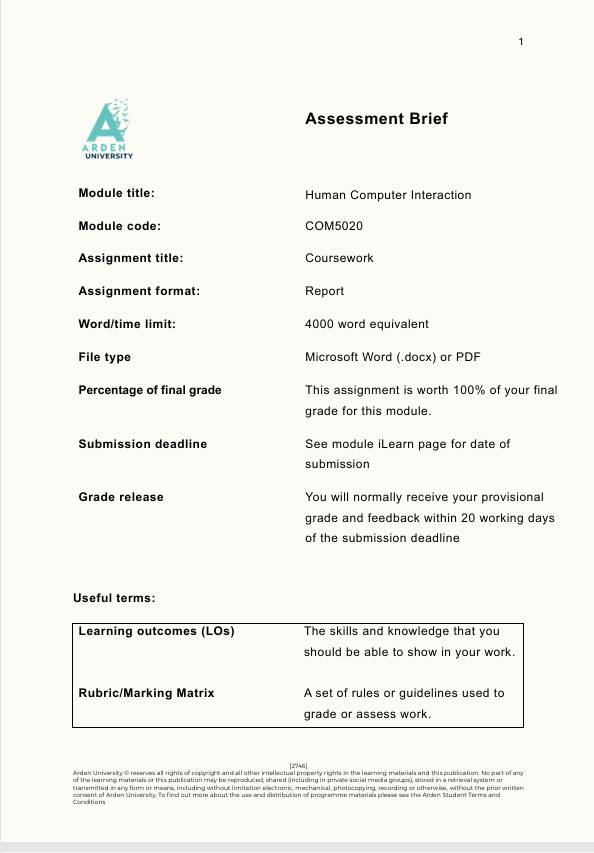
The COM5020 Human Computer Interaction assessment requires students to produce a professional report supported by a high-fidelity prototype and usability evaluation.
Module Details
- Module Title: Human-Computer Interaction
- Module Code: COM5020
- Assessment Format: Report
- Word Limit: 4000-word equivalent
- File Format: Microsoft Word (.docx) or PDF
- Assessment Weight: 100% of the Final Grade
The assignment assesses a student’s ability to design, explain, and evaluate an interactive application using recognised UX methodologies and Human-Computer Interaction principles.
Core Assessment Tasks
Students take the role of a professional User Experience (UX) Designer responsible for creating an application that satisfies user needs while providing an intuitive digital experience.
The assessment consists of three major components.
Part 1 – Design a High-Fidelity Paper Prototype
Students must develop a high-fidelity paper prototype representing the application’s interface.
The prototype should demonstrate:
- Navigation flow
- Screen layouts
- User interactions
- Interface consistency
- Visual hierarchy
- Accessibility considerations
The prototype serves as the foundation for later usability testing and evaluation.
Part 2 – Explain Design Decisions
Students justify every important design choice made throughout the development process.
Areas commonly discussed include:
- User-centred design principles
- Colour selection
- Typography
- Navigation structure
- Interaction design
- Accessibility features
- Consistency and usability
- Design heuristics
Every decision should be supported using Human-Computer Interaction theories and academic research.
Part 3 – Test and Evaluate the Prototype
Evaluation is a critical part of UX design.
Students test their prototype using representative users while collecting feedback on:
- Ease of use
- Navigation
- User satisfaction
- Task completion
- Interface clarity
- Accessibility
- Overall usability
Students then analyse the findings and recommend improvements based on user feedback.
Project Options
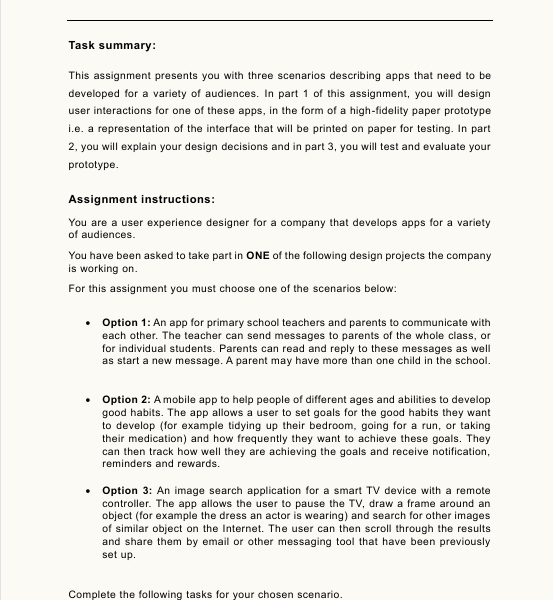
Students are required to select one of three design scenarios.
Each project focuses on solving real-world problems using user-centred design principles.
Option 1 – Communication App
This project requires students to design a communication application for primary school teachers and parents.
The application should allow teachers to:
- Send announcements to the whole class
- Send messages to individual parents
- Share important updates
- Manage classroom communication
Parents should be able to:
- Read messages
- Reply directly
- Start new conversations
- Manage communication for multiple children attending the same school
Students should design an interface that is simple, accessible, and easy for users with different levels of digital literacy.
Option 2 – Habit Tracker Application
The second project focuses on designing a mobile application that encourages users to develop healthy habits.
Users can create goals such as:
- Tidying their room
- Daily exercise
- Medication reminders
- Drinking water
- Reading books
- Improving sleep habits
The application should include useful features such as:
- Goal tracking
- Progress monitoring
- Daily reminders
- Achievement badges
- Notifications
- Rewards and motivation systems
The interface should remain easy to use for people of different ages and abilities while encouraging long-term engagement.
Option 3 – Smart TV Image Search Application
The third project introduces an innovative Human-Computer Interaction challenge involving Smart TV technology.
The application allows users to pause television content, highlight an object on the screen, and search online for visually similar products.
Key features include:
- Object selection
- Image recognition
- Similar image search
- Product browsing
- Sharing results through email
- Integration with messaging applications
Students must carefully consider remote-control navigation, large-screen usability, and interaction simplicity when designing the interface.
Why Students Find the COM5020 Assignment Challenging
The Arden University COM5020 Human Computer Interaction assignment requires students to combine creativity with technical knowledge. Unlike traditional written assessments, this module focuses on designing interactive digital experiences while supporting every design decision with recognised UX principles and academic research.
Many students find this assignment challenging because they must create a professional prototype, explain their design choices, and evaluate the usability of their solution. Every stage requires research, critical thinking, and practical application of Human-Computer Interaction concepts.
Some common challenges students face include:
- Understanding Human-Computer Interaction principles
- Creating a high-fidelity paper prototype
- Applying UX design methodologies
- Conducting usability testing
- Analysing user feedback
- Supporting design decisions with academic references
- Structuring a professional report
- Following Harvard referencing guidelines
Developing a successful assignment requires careful planning, continuous evaluation, and a clear understanding of user-centred design principles.
Human-Computer Interaction Principles
Human-Computer Interaction (HCI) focuses on designing systems that are easy, efficient, and enjoyable for users. Throughout the COM5020 module, students learn how good interface design improves usability, accessibility, and overall user satisfaction.
Some of the key HCI principles include:
- User-centred design
- Consistency across the interface
- Clear navigation
- Accessibility for different users
- Effective feedback mechanisms
- Error prevention
- Simple and intuitive interactions
- Visual hierarchy
Applying these principles helps students design applications that meet user needs while providing a smooth and engaging experience.
Creating an Effective High-Fidelity Prototype
The high-fidelity paper prototype is one of the most important parts of the assessment because it visually demonstrates how the application will function.
A strong prototype should include:
- Well-organised screen layouts
- Clear navigation paths
- Consistent interface design
- Easy-to-read typography
- Appropriate colours and icons
- Logical user interactions
- Accessible features
- Smooth user flow
The prototype should reflect professional UX design standards and provide a realistic representation of the final application.
Testing and Evaluating the Prototype
Testing allows students to identify usability problems before an application is developed. Gathering feedback from users helps improve the interface and ensures that the design meets user expectations.
Students should evaluate:
- Ease of navigation
- User satisfaction
- Task completion
- Interface clarity
- Accessibility
- Overall usability
After analysing the results, students should recommend practical improvements that enhance the user experience while supporting the objectives of the project.
Tips for Achieving Higher Marks
Producing a high-quality COM5020 report requires more than creating an attractive interface. Students should combine practical design skills with academic research and critical analysis.
To improve assignment quality, students should:
- Read the assignment brief carefully
- Choose the most suitable project option
- Apply recognised UX and HCI principles
- Create detailed and realistic prototypes
- Support design decisions with academic research
- Conduct meaningful usability testing
- Evaluate user feedback critically
- Use accurate Harvard referencing
- Proofread the report before submission
Following these practices can help students produce a well-structured assignment that meets university assessment criteria.
Benefits of Professional COM5020 Assignment Help
Many students seek assignment support because the COM5020 assessment combines technical design, research, usability evaluation, and report writing.
Professional academic assistance can help students with:
- Human Computer Interaction assignments
- UX design reports
- Prototype development
- Usability testing and evaluation
- Academic research
- Report structuring
- Harvard referencing
- Proofreading and editing
Expert guidance helps students understand assessment requirements while producing professional assignments that meet academic standards.
Why Choose Jira Assignment?
At Jira Assignment, we provide specialist academic support for students studying computer science, software engineering, UX design, and information technology modules across UK universities.
Our services include:
- Human Computer Interaction Assignment Help
- COM5020 Assignment Help
- UX Design Assignment Help
- Prototype Development Support
- Report Writing Assistance
- Harvard Referencing
- Plagiarism-Free Work
- On-Time Delivery
- Experienced Subject Experts
Our team understands university expectations and works closely with students to deliver high-quality assignments that demonstrate strong research, critical thinking, and practical knowledge.
Conclusion
The Arden University Human Computer Interaction COM5020 assignment gives students the opportunity to apply UX design principles, develop user-centred prototypes, and evaluate digital experiences using recognised Human-Computer Interaction techniques. Successfully completing this assessment requires creativity, research, critical analysis, and professional report writing. With the right preparation and expert academic support, students can confidently produce high-quality assignments that meet university standards and strengthen their practical UX design skills.